
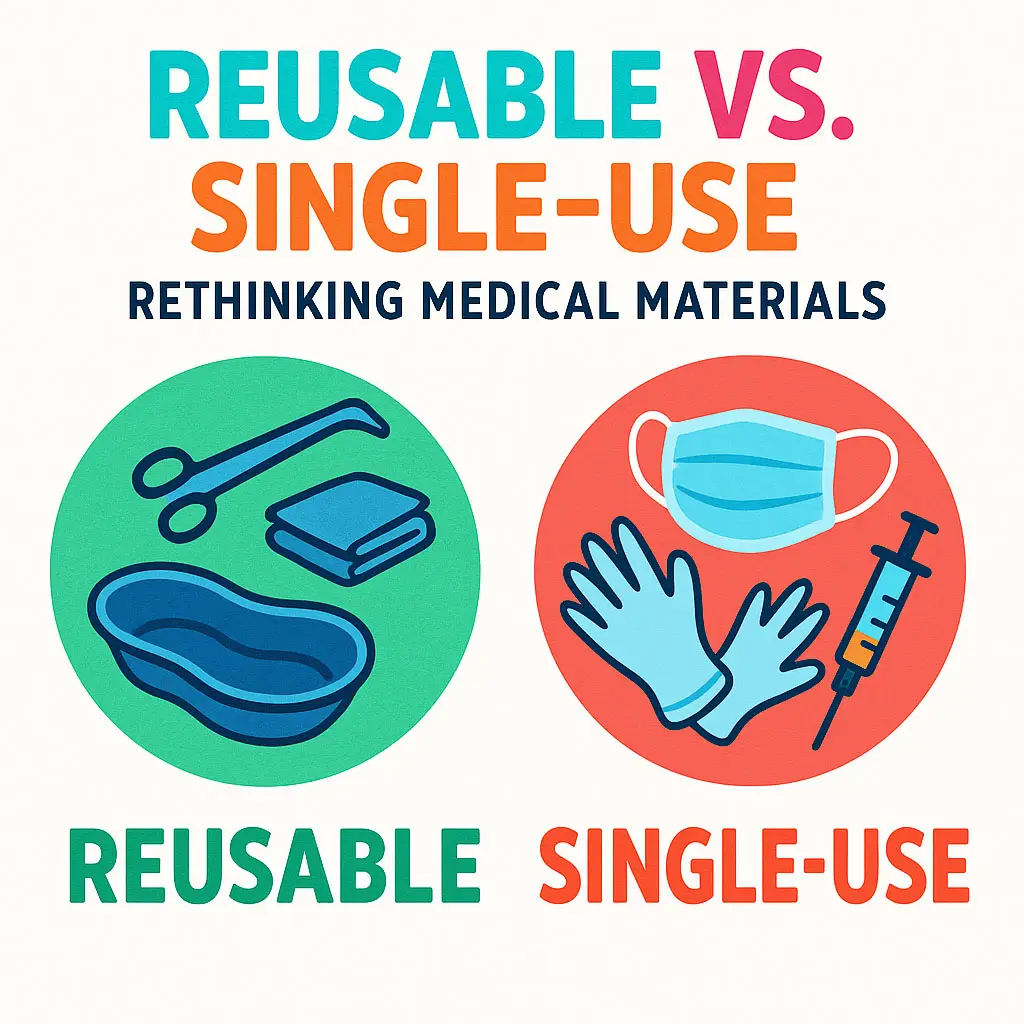
Disposable vs. Reusable Medical Products: Which Is Better for Healthcare?

Introduction: The “Best” Medical Product Depends on the Job

In healthcare, few decisions are as deceptively simple as choosing between disposable and reusable Medical Products.

A disposable syringe is opened, used, and discarded. A reusable surgical instrument may serve hundreds or even thousands of procedures—but only if it is correctly cleaned, disinfected or sterilized after every use.

So, which is better?

The honest answer is: neither option wins in every situation.

The better choice depends on infection risk, clinical purpose, reprocessing capabilities, total cost, product design, availability, and environmental impact. The World Health Organization (WHO) specifically encourages healthcare facilities to minimize waste and, where safe and viable, consider reusable products as part of broader sustainable procurement strategies.

That makes this less of a “disposable vs. reusable” debate and more of a “right product for the right clinical task” decision.


1773726071342?e=2147483647&v=beta&t=7BZpxjQoTNuQUgj03A6gzQC015W6uzCnGggbh7BVEZI

Disposable vs. Reusable Medical Products: What Is the Difference?

What Are Disposable Medical Products?

Disposable or single-use products are designed to be used once—or, depending on labeling, on a single patient during a single procedure—and then discarded.

Common examples include:

  • Syringes and needles
  • Gloves
  • Face masks
  • Disposable gowns
  • Certain catheters and tubing
  • Some wound-care products
  • Disposable examination instruments
  • Certain diagnostic accessories

Their biggest advantage is simplicity. Once the procedure is complete, the product does not need to enter a cleaning and sterilization cycle before the next use.

However, “throw away after use” does not mean “zero responsibility.” Used disposable products can become infectious, sharps, chemical, or other regulated waste depending on their contamination and composition. WHO estimates that around 15% of healthcare waste is hazardous, while the remaining 85% is generally non-hazardous.

What Are Reusable Medical Products?

Reusable products are specifically designed to be used multiple times after appropriate reprocessing.

Examples include:

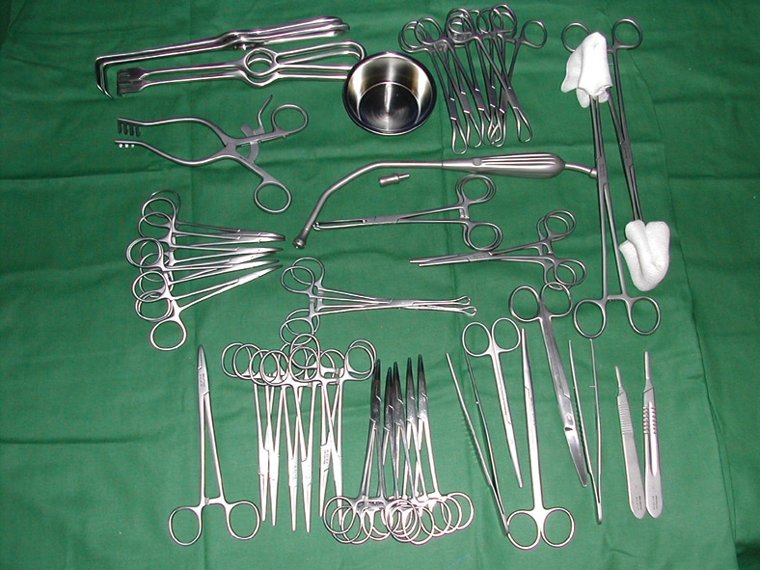
  • Surgical scissors
  • Forceps
  • Retractors
  • Some dental instruments
  • Stainless-steel trays
  • Certain surgical instruments
  • Reusable gowns and textiles
  • Some patient-care equipment

The important word is “appropriate.”

A reusable instrument is not simply wiped down and put back into circulation. The U.S. FDA explains that reprocessing generally involves cleaning followed by disinfection or sterilization according to the device’s intended use and manufacturer instructions.


Disposable vs. Reusable Medical Products: Side-by-Side Comparison

FactorDisposable Medical ProductsReusable Medical Products
Initial purchaseUsually lower per itemUsually higher
ReuseNo, when labeled single-useYes, when designed and approved for reuse
Cleaning requiredGenerally no reprocessing between usesYes
SterilizationUsually not required for another use because product is discardedOften required for critical instruments
Infection-control workflowSimple after useRequires validated reprocessing
Waste generationHigherGenerally lower per use
Staff timeLower reprocessing burdenHigher
Long-term costCan become expensive at high volumeOften economical over repeated use
Supply dependencyRequires continuous stockRequires effective instrument turnaround
Environmental considerationsMore material becomes wasteCan reduce waste, but consumes water, energy and processing resources
Best suited toHigh-volume, low-complexity or single-use applicationsDurable instruments and repeated procedures

The table reveals an important point: purchase price is only one part of the equation.

A hospital buying a reusable instrument for ₹1,000 cannot compare it fairly with a ₹100 disposable instrument without considering how many times the reusable product can safely be used, how much reprocessing costs, and how much staff time is involved.


1. Infection Control: Where Disposable Products Have a Clear Advantage

When contamination risk is high and safe reprocessing is impractical, disposable products can offer a straightforward infection-control strategy.

There is no need to transport a contaminated item to a sterilization department, clean it, inspect it, package it and sterilize it before another patient uses it.

This can be particularly useful in:

  • Emergency situations
  • High-throughput clinics
  • Certain isolation settings
  • Procedures involving products that are difficult to clean
  • Settings where sterilization infrastructure is limited

But disposables are not automatically risk-free.

Incorrect handling, storage, reuse of single-use items, poor hand hygiene, and improper waste disposal can still create risks.

WHO emphasizes that healthcare waste can expose healthcare workers, waste handlers and communities to infectious materials, toxic substances and injuries when it is poorly managed.


2. Reusable Products Can Be Excellent—If the Reprocessing System Is Excellent

Reusable Medical Products make economic and environmental sense only when the healthcare facility has the infrastructure and discipline to reprocess them correctly.

The FDA describes reprocessing as a multistep process that can include point-of-use treatment, thorough cleaning, and then disinfection or sterilization depending on the device.

That means a reusable instrument’s real cost includes much more than its purchase price.

The hidden costs may include:

  • Water
  • Electricity
  • Sterilization equipment
  • Cleaning chemicals
  • Packaging materials
  • Maintenance
  • Staff training
  • Quality-control procedures
  • Instrument inspection
  • Replacement of damaged instruments
  • Storage and inventory management

This is why a facility should never evaluate reusable products simply by asking, “How many times can we use this?”

The better question is:

“Can we reliably reprocess this product to the required standard every time?”

If the answer is no, the theoretical savings of reuse can disappear very quickly.


3. The Economics: Look Beyond the Purchase Price

One of the biggest mistakes in medical procurement is comparing products based only on unit price.

Consider a clinic that performs 5,000 procedures annually.

A disposable item costing ₹50 could represent ₹2.5 lakh in annual purchasing expense.

A reusable alternative might cost ₹500 initially and survive hundreds of validated use cycles. But if every cycle requires cleaning, sterilization, packaging and labor, the actual cost per use could be significantly different from the purchase price.

A better calculation is:

Total Cost of Ownership = Purchase Cost + Reprocessing + Labor + Maintenance + Replacement + Waste Management

This approach is particularly important for hospitals, dental clinics, laboratories and diagnostic centers where products are used repeatedly.

In some situations, reusable instruments become more economical over time. In others, the simplicity of disposables makes them the better financial decision.


4. Sustainability: Is Reusable Always Greener?

This is where the discussion becomes more interesting.

It is tempting to assume:

Reusable = environmentally friendly
Disposable = environmentally harmful

Real-world healthcare is more complicated.

Reusable products can reduce the amount of physical waste generated per procedure. WHO recommends waste minimization and notes that switching to reusable products can be appropriate when safe and viable.

But reusable products require:

  • Water
  • Energy
  • Detergents
  • Sterilization
  • Transportation within the facility
  • Packaging
  • Equipment maintenance

Meanwhile, disposable products require manufacturing and transportation and ultimately create waste that must be segregated and treated appropriately.

Therefore, environmental performance should ideally be assessed through a life-cycle perspective, rather than simply counting how many products enter a waste bin.

WHO’s guidance on environmentally sustainable healthcare facilities emphasizes optimizing resources and minimizing environmental releases while maintaining safe, high-quality care.


5. The Middle Ground: Smarter Medical Procurement

The strongest healthcare systems do not necessarily choose one category exclusively.

Instead, they build a hybrid product strategy.

For example:

Choose disposable products when:

  • The item is labeled for single use.
  • Reprocessing is unsafe or impractical.
  • The product has complex internal surfaces that are difficult to clean.
  • Rapid turnover is critical.
  • Sterilization capacity is limited.
  • The clinical risk justifies single-use design.

Choose reusable products when:

  • The product is specifically designed for repeated use.
  • Reliable cleaning and sterilization systems are available.
  • The product is durable.
  • High procedure volumes justify the investment.
  • Reprocessing can be consistently validated.
  • Waste reduction is an important operational goal.

This approach is more practical than treating sustainability or infection prevention as an all-or-nothing choice.


6. Don’t Reuse a Single-Use Product Just to Save Money

One particularly important distinction is between a manufacturer-designated reusable device and a product labeled for single use.

A single-use device should not automatically be treated as reusable simply because it appears physically intact.

The FDA notes that reprocessing single-use devices is a regulated activity in the United States, with requirements intended to demonstrate that the device can withstand cleaning, disinfection or sterilization and continue to meet applicable safety and performance requirements.

For healthcare organizations, the lesson is simple:

Follow the manufacturer’s instructions for use and applicable local regulations.

A product that looks reusable may not actually be designed to withstand repeated sterilization, mechanical stress or chemical exposure.


7. The Often-Ignored Factor: Staff Workflow

A medical product does not exist in isolation. It becomes part of a workflow.

Imagine two hospitals performing the same procedure.

Hospital A has:

  • A modern central sterilization department
  • Trained technicians
  • Automated cleaning equipment
  • Reliable sterilization monitoring
  • Strong instrument tracking

Reusable products may work extremely well.

Hospital B has:

  • Limited sterilization capacity
  • High patient volume
  • Inadequate instrument turnaround
  • Limited trained staff

The same reusable product may create bottlenecks and increase operational risk.

This is why procurement teams should involve clinicians, infection-control professionals, sterilization teams and operations managers—not just purchasing departments.


8. A Better Way to Choose Medical Products

Before buying either disposable or reusable products, ask these questions:

Clinical questions

  • What procedure will the product be used for?
  • What level of contamination is expected?
  • Is the product critical, semicritical or noncritical?
  • What infection-control requirements apply?

Operational questions

  • Do we have adequate cleaning and sterilization capacity?
  • How quickly does the product need to be available again?
  • Can staff consistently follow the manufacturer’s reprocessing instructions?

Financial questions

  • What is the cost per use?
  • What are the labor and sterilization costs?
  • How often will the product need replacement?
  • What is the five-year total cost of ownership?

Sustainability questions

  • How much waste does each option generate?
  • What resources are required for reprocessing?
  • Can packaging be reduced?
  • Is recycling or appropriate waste treatment available?

Procurement questions

  • Is the product from a reliable manufacturer?
  • Are instructions for use clearly available?
  • Is the product compliant with applicable regulatory requirements?
  • Can supply remain consistent during demand spikes?

Disposable vs. Reusable: The Real Winner Is the Right System

The debate often focuses on the product.

But healthcare quality is ultimately determined by the system around the product.

A disposable syringe can be an excellent choice when single-use protection is essential. A reusable surgical instrument can be an equally excellent choice when a facility has robust reprocessing systems.

The goal is not to eliminate disposables or maximize reuse.

The goal is to achieve the best balance of:

Patient safety + infection prevention + cost efficiency + operational reliability + environmental responsibility.

WHO’s current healthcare-waste guidance places waste minimization, safe segregation and environmentally sound management at the center of sustainable healthcare.


Key Takeaways

  • Disposable Medical Products offer convenience and eliminate the need for routine reprocessing between patients.
  • Reusable Medical Products can reduce waste and deliver strong long-term value when properly reprocessed.
  • Reusable does not mean risk-free; inadequate reprocessing can allow biological contamination to remain.
  • Disposable does not mean environmentally neutral; manufacturing, packaging and disposal all have impacts.
  • Total cost of ownership is more useful than purchase price alone.
  • Product selection should consider clinical risk, workflow, infrastructure, cost and sustainability together.
  • Never reuse a product labeled for single use unless it has been appropriately reprocessed under an authorized, regulated framework.

Conclusion: Healthcare Needs Smarter Choices, Not Simple Choices

There is no universal winner in the disposable-versus-reusable debate.

The best Medical Products are the ones that match the clinical task, the patient’s safety requirements and the facility’s ability to use them correctly.

For a busy clinic, a disposable product may save time and simplify infection-control workflows. For a hospital with a highly capable sterilization department, a durable reusable instrument may deliver years of value.

The future of healthcare procurement is therefore unlikely to be “disposable everything” or “reusable everything.”

It is more likely to be intentional everything—choosing each product based on evidence, risk, total cost and real-world performance.

Ready to Make Better Medical Product Decisions?

Whether you’re managing a hospital, dental clinic, laboratory or healthcare supply operation, evaluate products beyond their unit price. Compare quality, intended use, regulatory compliance, reprocessing requirements, availability and total cost of ownership before making your next purchase.

Explore your healthcare product range, compare suitable options, and choose Medical Products that support safer, more efficient and more sustainable care.


Suggested Visual Elements

Comparison infographic:
“Disposable vs. Reusable Medical Products” with five comparison points: Infection Control, Cost, Reprocessing, Waste, and Sustainability.

Research sources:
WHO — Health-care Waste · FDA — Reprocessing Reusable Medical Devices · WHO — Environmentally Sustainable Health Care Facilities
Leave a Reply

Your email address will not be published. Required fields are marked *

Related Post

52b95d5d81c3fcc47b79fb85e7105d8d10dfe746 2 1024x682

Pharmacy & Healthcare Essentials: Medicines, Everyday Health Products & Smart Product Awareness

Introduction: The Aisle Everyone Walks Through, But Few Really Understand Think about the last time you stood in a pharmacy aisle, scanning ten nearly identical boxes of cold medicine, unsure which one actually matched your symptoms. You’re not alone — most of us treat pharmacy healthcare decisions the same way we treat grocery shopping: quick, instinctive, and based on packaging rather than substance. But here’s the catch. Unlike a bag of chips, the wrong choice in a pharmacy aisle can interact badly with a medication you’re already taking, mask a symptom that needed attention, or — in a worrying number of cases — turn out to be counterfeit altogether. Pharmacy healthcare isn’t just about grabbing a bottle off a shelf; it’s a small, frequent decision that quietly shapes how well your body recovers, and how safely. This post breaks down the three things that actually matter in everyday pharmacy healthcare: understanding medicines, using everyday health products correctly, and building the kind of product awareness that protects you from bad — sometimes dangerous — purchases. Understanding Medicines: Prescription vs. Over-the-Counter Every medicine sold legally falls into one of two buckets, and knowing the difference changes how carefully you should treat it. Prescription (Rx) Medicines These require a doctor’s evaluation because the risk of misuse, incorrect dosing, or dangerous interaction is high enough that professional oversight is built into the system. Over-the-Counter (OTC) Medicines The FDA defines OTC medicines as products the agency has determined are safe and effective for consumers to use without a doctor’s supervision — but only <cite index=”7-1″>when you follow the directions on the label and as directed by your health care professional</cite>. That “only if” clause is where most people slip up. Interestingly, the boundary between these two categories isn’t fixed. Through a process called Rx-to-OTC switch, <cite index=”9-1″>more than 700 products sold over the counter today use ingredients or dosage strengths that were available only by prescription three decades ago</cite>. Allergy medicines, certain heartburn drugs, and pain relievers have all made this journey — which is exactly why label literacy matters more now than ever. The Drug Facts Label: Your Five-Second Safety Check Before buying anything, the FDA’s Drug Facts label tells you everything that matters in one glance: Label Section What It Tells You Why It Matters Active ingredient The actual drug compound Prevents accidental double-dosing on the same ingredient across two products Purpose What condition it treats Confirms it actually matches your symptom Warnings Who shouldn’t take it, and interactions Flags risks for pregnancy, allergies, or existing conditions Directions Dose, frequency, age limits The single biggest source of preventable harm when ignored Inactive ingredients Fillers, dyes, preservatives Critical for people with allergies or sensitivities A simple habit — reading this box before checkout, not after you’re already home — solves a surprising share of medicine-related problems before they start. Everyday Health Products: Small Choices, Real Consequences Pharmacy healthcare isn’t only about pills. Thermometers, glucose monitors, wound-care supplies, vitamins, contact lens solutions, and even sunscreen fall under the same regulatory and safety logic — and the same room for error. A few patterns worth knowing: These aren’t dramatic rules. They’re boring, repeatable habits — which is exactly why they work. Smart Product Awareness: Spotting What Doesn’t Belong on the Shelf This is the part most “health tips” articles skip, and it’s arguably the most important one in 2026. The Counterfeit Problem Is Bigger Than Most People Assume A recent global analysis found that <cite index=”12-1″>around one in ten medicines sold worldwide is thought to be either counterfeit or substandard</cite>, and <cite index=”12-1″>roughly 60% of people surveyed said they fear the medicine they buy could be fake</cite> — a fear that turns out to be well-founded. The risk isn’t evenly spread, though. It concentrates heavily online: the World Health Organization estimates that <cite index=”13-1″>over 50% of medicines purchased from online pharmacies operating outside legitimate regulatory channels are counterfeit</cite>, compared with <cite index=”13-1″>less than 1% of medicines sold through licensed U.S. brick-and-mortar pharmacies</cite>. Online convenience has a dark side. According to the National Association of Boards of Pharmacy, <cite index=”11-1″>about 95% of online entities selling prescription medicine do so illegally</cite> — often mimicking real pharmacy branding closely enough that most shoppers can’t tell the difference. A Quick Comparison: Legitimate vs. Risky Pharmacy Sources Signal Legitimate Pharmacy Red Flag Source Prescription requirement Always asked for Rx drugs Sells prescription drugs with no prescription Pricing Consistent with market rate Unusually cheap, “too good to pass up” Licensing Verifiable pharmacist and state license No verifiable license or address Packaging Sealed, labeled, matches manufacturer standard Mismatched fonts, missing expiry dates, foreign-language labels with no translation Domain/verification Checkable via FDA’s BeSafeRx or similar tools No verification tool returns a match Practical Habits for Smarter Pharmacy Healthcare Decisions Key Insights: What Ties It All Together Conclusion: Make the Small Decisions Count Pharmacy healthcare rarely feels high-stakes in the moment — it’s a five-minute errand sandwiched between other tasks. But those small, frequent choices about medicines and everyday health products add up to a meaningful chunk of your family’s overall wellbeing. The good news is that the fixes aren’t complicated: read the label, ask your pharmacist, verify unfamiliar sellers, and treat “too cheap to be true” as exactly that. What’s your take? Have you ever caught a labeling issue, a dosing mistake, or a suspicious online “pharmacy” before it caused a problem? Share your experience in the comments — and if this guide helped you look at your medicine cabinet differently, pass it along to someone who could use the reminder. For more practical, well-sourced health guidance, explore our other posts on everyday wellness and consumer safety.

SunriseHospitalTour013118 004 1536x1001 1

How to Compare Medical Equipment Before Buying: A Complete Buyer’s Guide

Buying medical equipment is rarely as simple as choosing the model with the lowest price or the longest list of features. A device may look impressive on paper yet prove difficult to maintain, expensive to operate, or poorly suited to your clinic’s workflow. The smarter approach is to compare Medical Equipment as a complete investment—not just a product. Whether you are setting up a new clinic, upgrading a hospital department, replacing an outdated device, or expanding your diagnostic capabilities, the right comparison process can protect your budget while improving patient care. The World Health Organization (WHO) recommends considering technical specifications before purchasing medical devices because good specifications support appropriate selection, implementation, maintenance, and eventual decommissioning. This guide explains exactly what to compare, what questions to ask suppliers, and which seemingly small details can make a major difference after the purchase. Why Comparing Medical Equipment Matters Two machines can perform the same basic function but deliver very different ownership experiences. Consider two patient monitors. One costs less initially, but its sensors are proprietary, replacement parts take weeks to arrive, and staff require extensive training. The second costs slightly more but uses readily available accessories, has local technical support, and requires less downtime. Which one is cheaper? The answer may change completely once you consider its entire operating life. WHO’s current health-technology-management guidance treats equipment management as a lifecycle process extending from needs assessment and procurement through inspection, training, maintenance, and decommissioning. That is why a good comparison should evaluate: Step 1: Start With the Clinical Need—not the Brand One of the most common purchasing mistakes is starting with a product catalogue. Instead, begin with the question: “What problem are we trying to solve?” For example, a small outpatient clinic may need a compact, reliable vital-signs monitor. A large hospital may prioritize connectivity, continuous monitoring, data integration, and high patient throughput. Before comparing brands, write down: WHO’s procurement guidance emphasizes needs assessment and defining minimum performance and operational requirements before selecting specific products. This simple change prevents a surprisingly expensive mistake: buying technology because it is impressive rather than because it is necessary. Step 2: Create a Technical Comparison Sheet Never compare equipment from memory. Create one standardized specification sheet and ask every supplier to complete the same fields. This makes differences much easier to identify. Comparison Factor What to Check Why It Matters Intended use Clinical applications Prevents buying unsuitable equipment Accuracy Measurement accuracy and tolerance Directly affects clinical decisions Capacity Patients/tests per hour Determines workflow efficiency Dimensions Size and footprint Ensures adequate space Power Voltage, consumption, backup requirements Important for installation and continuity Connectivity USB, Ethernet, Wi-Fi, HL7 or other interfaces Supports data integration Consumables Type, availability, cost Influences recurring expenses Maintenance Preventive maintenance requirements Helps predict downtime Warranty Duration and coverage Reduces financial risk Service Response time and technician availability Critical when equipment fails Training Included training and materials Supports safe operation Expected lifespan Manufacturer guidance Helps calculate long-term value The goal is not to find the product with the longest specification sheet. It is to find the equipment whose specifications best match your actual clinical environment. Step 3: Look Beyond the Purchase Price The purchase price is only the beginning. A more useful calculation is Total Cost of Ownership (TCO). A simple TCO formula Total Cost of Ownership = Purchase Price + Installation + Training + Consumables + Maintenance + Repairs + Software/Service Fees − Residual Value For example, suppose: At first glance, Equipment A looks like the obvious choice. But if A requires expensive consumables and frequent servicing while B has lower operating costs and better local support, B could become the more economical option over five years. WHO procurement guidance specifically notes that the most economically advantageous purchase is not necessarily the lowest tender price; delivery, installation, commissioning, training, warranty, and after-sales service also matter. The cheapest machine is not necessarily the cheapest machine to own. Step 4: Compare Quality, Safety and Compliance Price and features should never outrank patient safety. Ask suppliers for documentation demonstrating that the equipment meets the regulatory and quality requirements applicable to your market and intended use. Depending on the product and jurisdiction, this may include: For manufacturers, ISO 13485 is an internationally recognized quality-management standard specifically addressing medical devices. ISO says the standard helps organizations consistently provide medical devices and related services that meet customer and regulatory requirements. However, certification should be treated as one part of due diligence, not as an automatic guarantee that a particular model is perfect for your facility. Always verify the specific product, manufacturer, regulatory status, and documentation. Step 5: Compare Usability—Because Staff Time Has a Cost A technically advanced device can become a poor investment if staff struggle to operate it. Ask your clinical team to evaluate the equipment directly whenever possible. Look at: A useful test is to ask an actual operator to perform a typical procedure without assistance. Watch where they hesitate. Those moments are valuable purchasing information. A machine that saves 30 seconds per patient may not sound revolutionary. But at 40 patients per day, that becomes 20 minutes every day. Over hundreds of working days, small workflow improvements can become significant. Step 6: Investigate Maintenance and Service Support This is where many purchasing decisions go wrong. Equipment does not become valuable merely because it works on installation day. It must continue working reliably months and years later. WHO describes maintenance as including performance inspections, safety inspections, preventive maintenance, and corrective maintenance. Preventive maintenance is intended to extend equipment life and reduce failures. Before buying, ask: Service questions A supplier who gives vague answers before the sale may not become more responsive after it. Step 7: Compare Consumables and Accessories Sometimes the machine is affordable because the recurring products are expensive. Check every item needed to operate the equipment: Then ask whether those items are proprietary or compatible with standardized alternatives. A device requiring a ₹500 consumable for every procedure can become dramatically more expensive than a machine using a

dentists meeting medical colleagues discussing teeth problems dental clinic young professional doctors studying jaw ray 62382915

For Healthcare Professionals: Practical Insights for Dentists, Doctors, Clinics & Hospitals

Picture this: a small dental practice spends years building trust with its patients, one cleaning and one kind word at a time. Then one morning, its website — the same one that quietly collects appointment requests and new-patient forms — gets flagged for serving malware. Within a week, patient records are for sale on a forum neither the dentist nor her office manager has ever heard of. This isn’t a rare horror story anymore. It’s Tuesday. For healthcare professionals, the website has quietly become one of the most exposed parts of the practice — and most clinics never planned for that. This post breaks down what’s actually happening, how it compares across practice types, and what you can do about it this month, not “eventually.” Why This Is Suddenly Everyone’s Problem Healthcare has held the unwanted title of the costliest industry for data breaches for 14 straight years, with the average incident now running $7.42 million. That number sounds like a hospital-only problem — it isn’t. Small practices, dental offices, and single-location clinics get swept into the same statistics because attackers don’t discriminate by practice size; they discriminate by how easy the target is. The shift in attack methods matters just as much as the cost. Hacking and IT-related incidents now account for more than 80% of large healthcare breaches, up from roughly half that share back in 2019. Ransomware alone drives nearly half of all confirmed healthcare breaches in 2026, and for the first time in nearly two decades of tracking, exploiting unpatched software vulnerabilities has overtaken stolen passwords as the top way attackers get in. That detail matters enormously for anyone running a website on a content management system that needs regular updates. The Comparison: Where Different Practices Are Exposed Not every healthcare setting carries the same risk profile. Here’s a practical breakdown of where the pressure points typically sit. Practice Type Common Website Function Typical Weak Point Priority Fix Solo dental/medical practice New patient intake forms, appointment requests Outdated CMS plugins, no BAA with host Patch management + compliant hosting Multi-location clinic Booking systems, provider portals Inconsistent access controls across sites Centralized, role-based access Specialty/therapy practice Secure messaging, telehealth links Third-party embeds without vendor agreements Vendor risk review + signed BAAs Hospital system EHR integration, patient portal Business associate exposure, legacy systems Third-party monitoring + audit logging Third-party vendors deserve special attention here. Business associates are now named in roughly one in three reported healthcare breaches, and that share has doubled in a single year. If your website hands appointment data, chat widgets, or analytics to an outside company without a signed Business Associate Agreement, that gap is treated by regulators as its own violation — not a minor technicality. Key Insight #1: Your Website Platform Wasn’t Built for PHI, and That’s Fine — If You Know It A huge share of clinic and practice websites run on WordPress, which is understandable: it’s flexible, familiar, and inexpensive. But it’s worth being clear-eyed about a specific point that trips up a lot of practices — WordPress is not HIPAA-compliant out of the box. Compliance isn’t a feature you install; it’s a property of how the whole environment — hosting, plugins, forms, and vendor contracts — is configured and maintained together. That doesn’t mean healthcare organizations should avoid WordPress. It means treating any part of the site that touches protected health information (appointment forms, secure messaging, patient portals) differently from the marketing pages describing your services. One widely echoed piece of advice from web architects working in healthcare is refreshingly simple: don’t store sensitive patient information directly inside WordPress at all — route it instead to purpose-built, compliant systems designed to hold that data securely. Key Insight #2: Hosting Is the Foundation, Not an Afterthought If there’s one decision that quietly determines your entire security posture, it’s who hosts your site. Standard consumer hosting — the kind marketed on price and ease of setup — typically will not sign a Business Associate Agreement or meet PHI protection standards like encryption at rest and audit logging. A healthcare website deserves the digital equivalent of the physical security you already apply to paper charts in a locked filing cabinet. Practical signs your hosting is doing its job: Key Insight #3: Multi-Factor Authentication Is the Cheapest Insurance You’ll Ever Buy Ask any security consultant working with clinics what single change stops the most incidents, and multi-factor authentication comes up almost every time — particularly for anything resembling a patient portal or staff login. It costs little, takes minutes to enable, and closes off the majority of credential-based attacks that once dominated the threat landscape. Given that external actors are behind roughly two-thirds of confirmed healthcare breaches, and financial motives drive the vast majority of them, making stolen credentials useless on their own is one of the highest-leverage moves a small practice can make. Key Insight #4: The Detection Gap Is Longer Than You’d Think Healthcare breaches take an average of 279 days to identify and contain — the longest of any industry tracked. Translate that into practice terms: a compromise discovered today may have been sitting quietly since roughly last spring. This is precisely why routine monitoring, logging, and even a simple quarterly review of who has admin access to your website matter more than a one-time security push. Set-and-forget security is, in practice, forget-and-regret. What This Means for Your Practice, Starting This Month None of this requires a hospital-sized IT budget. A realistic starting checklist looks like: A Final Word The trust patients place in a dental chair or an exam room extends, whether we’ve fully reckoned with it or not, to the “Book an Appointment” button on the website. Protecting that trust isn’t about becoming a cybersecurity expert overnight — it’s about treating your digital front door with the same seriousness as your physical one. If this rundown raised questions about your own practice’s setup, that’s worth sitting with rather than shrugging off. Talk to your web host today