
Category: Ophthalmology | Medical Specialist: Ophthalmologist; optometrist for appropriate conditions | References: American Academy of Ophthalmology (AAO); WHO; CDC
Introduction: The Eye Disease You May Not Notice
Imagine gradually losing part of your vision without realizing it. You can still read, recognize faces, and use your phone—yet your peripheral vision is quietly narrowing.
That is one of the most troubling things about Glaucoma: in its most common forms, it can progress for years with few or no noticeable symptoms. By the time vision changes become obvious, permanent optic nerve damage may already have occurred. The National Eye Institute notes that many people with glaucoma do not know they have it because early disease often causes no symptoms.
The good news is equally important: early detection and appropriate treatment can slow or stop further vision loss.
This guide explains what glaucoma is, why it develops, which symptoms deserve attention, how doctors diagnose it, and how modern treatment can help preserve sight.
What Is Glaucoma?
Glaucoma is not a single disease but a group of eye conditions that damage the optic nerve, the structure responsible for carrying visual information from the eye to the brain. If the damage progresses, it can lead to irreversible vision loss or blindness.
A useful way to understand the optic nerve is to think of it as a communication cable. The retina collects visual information, while the optic nerve transmits that information to the brain. Glaucoma gradually damages the nerve fibers within this pathway.
Is glaucoma the same as high eye pressure?
No.
High intraocular pressure (IOP) is an important risk factor, but it does not automatically mean someone has glaucoma. Some people have elevated eye pressure without optic nerve damage, while others develop glaucoma despite having pressure within the range traditionally considered normal.
This is why a pressure reading alone cannot diagnose glaucoma.
Types of Glaucoma
Different forms of glaucoma develop in different ways.
| Type | What happens | Typical pattern |
|---|---|---|
| Primary open-angle glaucoma | Fluid drains too slowly through the eye’s drainage system | Usually gradual and painless |
| Angle-closure glaucoma | The drainage angle becomes blocked | May develop suddenly and requires urgent treatment |
| Normal-tension glaucoma | Optic nerve damage occurs despite apparently normal eye pressure | Often gradual |
| Congenital glaucoma | Abnormal development of the eye’s drainage system | Usually appears during infancy or childhood |
| Secondary glaucoma | Develops because of another condition, medication, injury, or eye problem | Depends on the underlying cause |
Primary open-angle glaucoma is the most common form in the United States, while angle-closure glaucoma is less common but can become an emergency.
What Causes Glaucoma?
There isn’t one universal cause.
In many cases, the problem involves the way fluid called aqueous humor circulates and drains through the eye. When drainage is impaired, pressure may increase and contribute to optic nerve damage. However, the relationship between pressure and nerve damage is more complicated than simply saying “high pressure causes glaucoma.”
Researchers continue to investigate why some optic nerves are more vulnerable than others.
Important glaucoma risk factors
Your risk may be higher if you have:
- Increasing age
- A family history of glaucoma
- Elevated eye pressure
- Certain racial or ethnic backgrounds associated with higher risk
- Previous eye injury
- Certain medical conditions
- Long-term use of corticosteroids in some circumstances
- Certain structural characteristics of the eye
Having a risk factor does not mean you will definitely develop glaucoma. It simply makes regular eye examinations more important.
Glaucoma Symptoms: Why Early Detection Matters
The most difficult thing about glaucoma is that the early stages can be almost invisible.
Early symptoms
For many people with open-angle glaucoma, there are no noticeable early symptoms. Vision can appear completely normal while optic nerve damage is occurring.
As the condition progresses, people may develop:
- Loss of peripheral or side vision
- Difficulty noticing objects to the side
- Increasing blind spots
- A narrowing field of vision
- In advanced cases, severe vision loss or blindness
Peripheral vision may disappear gradually, which means the brain can adapt to changes without the person immediately recognizing what is happening.
Acute angle-closure glaucoma: know the warning signs
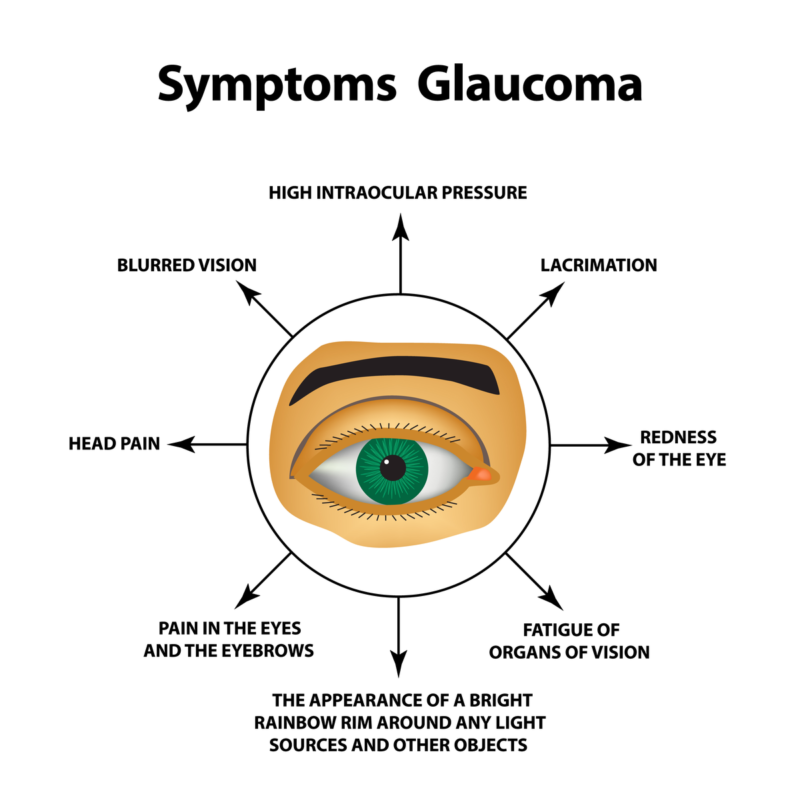
Angle-closure glaucoma can sometimes develop suddenly. Symptoms can include:
- Severe eye pain
- Redness of the eye
- Sudden blurred vision
- Nausea or vomiting
- Significant headache or discomfort
These symptoms require urgent medical attention because acute angle closure can threaten vision quickly.
How Is Glaucoma Diagnosed?
A common misconception is that a quick “eye pressure test” is enough.
It isn’t.
A comprehensive eye examination may include several assessments that work together to determine whether the optic nerve is healthy.
1. Tonometry
This measures intraocular pressure.
Although useful, pressure is only one piece of the puzzle. A single normal pressure measurement does not rule out glaucoma.
2. Dilated eye examination
The eye specialist examines the retina and optic nerve through a dilated pupil to look for structural signs of damage.
3. Visual field testing
This checks how well you can see objects in different parts of your visual field. It can identify peripheral vision loss that you may not have noticed in everyday life.
4. Optic nerve imaging
Modern eye clinics may use technologies such as optical coherence tomography (OCT) to measure and monitor the retinal nerve fiber layer and other structures.
5. Additional testing
Depending on the situation, your ophthalmologist may evaluate the drainage angle, corneal thickness, optic nerve appearance, and changes over time.
The key insight is simple: glaucoma diagnosis is based on a combination of structural and functional information, not one number.
Glaucoma Treatment: Protecting the Vision You Still Have
There is currently no cure that reverses established glaucomatous optic nerve damage. However, treatment can often slow or prevent additional damage.
The central treatment goal is generally to reduce the risk of further optic nerve damage, commonly by lowering eye pressure.
1. Prescription eye drops
Eye drops are among the most common treatments.
Different medications work in different ways. Some increase fluid drainage, while others reduce the amount of fluid produced inside the eye. Prostaglandin analogues, beta blockers, alpha agonists, carbonic anhydrase inhibitors, and other medication classes may be used depending on the patient’s needs.
One practical challenge is adherence.
Glaucoma drops may not make you feel better because glaucoma often causes no symptoms. That can make it tempting to skip doses. But the purpose of treatment is not necessarily to improve today’s vision—it is to protect tomorrow’s vision.
2. Laser treatment
Laser procedures can improve fluid drainage and lower eye pressure in appropriate patients.
Depending on the type of glaucoma, procedures may include laser trabeculoplasty or other laser techniques.
Laser treatment isn’t automatically “better” than medication. The appropriate option depends on the type and severity of glaucoma, eye anatomy, treatment goals, and the ophthalmologist’s assessment.
3. Surgery
If medication and/or laser treatment do not adequately control glaucoma, surgery may be considered.
Procedures can create or improve alternative pathways for fluid drainage. The choice depends on factors such as disease severity, previous treatments, eye anatomy, and expected benefit.
The goal remains the same: preserve remaining optic nerve function and prevent further vision loss.
Glaucoma vs. Cataracts: What’s the Difference?
People sometimes confuse glaucoma with cataracts because both can affect vision, particularly as people age.
| Feature | Glaucoma | Cataract |
| Main structure affected | Optic nerve | Eye’s natural lens |
| Typical vision problem | Often begins with peripheral vision loss | Blurry, cloudy, or hazy vision |
| Pain | Usually painless; acute angle closure can be painful | Usually painless |
| Reversibility | Existing optic nerve damage cannot generally be reversed | Cataract-related vision loss can often be treated surgically |
| Main treatment | Pressure-lowering medicines, laser, or surgery | Cataract surgery when vision impairment warrants it |
This distinction matters because treatment is completely different.
Can Glaucoma Be Prevented?
There is currently no guaranteed way to prevent glaucoma. But you can reduce the chance of discovering it too late.
Protect your vision with these habits
- Schedule comprehensive eye examinations according to your eye specialist’s recommendations.
- Tell your eye doctor if glaucoma runs in your family.
- Follow prescribed treatment consistently.
- Report medication side effects rather than stopping treatment on your own.
- Protect your eyes from significant injuries.
- Tell your doctor about medicines, including steroid medications, that you use.
- Seek urgent care for sudden severe eye pain, redness, nausea, or blurred vision.
For people at increased risk, the National Eye Institute recommends regular comprehensive dilated eye examinations, with frequency individualized according to risk.
A Fresh Perspective: The Best Glaucoma Treatment Is Often the One You Can Sustain
One of the less-discussed realities of glaucoma care is that successful treatment isn’t simply about choosing the most sophisticated procedure.
It is also about long-term consistency.
A patient may have an excellent medication prescribed but struggle to remember multiple daily doses. Another person may benefit from a laser procedure that reduces dependence on drops. Someone else may need surgery because their disease is advanced.
That is why glaucoma treatment should be individualized.
The most useful question isn’t simply, “Which treatment is strongest?”
It is:
“Which treatment can safely control my disease while fitting realistically into my life?”
Regular follow-up then becomes just as important as the initial treatment decision.
When Should You See an Eye Specialist?
Don’t wait for obvious vision loss.
Make an appointment if you:
- Have a family history of glaucoma
- Have been told your eye pressure is high
- Notice changes in peripheral vision
- Have experienced an eye injury
- Have other risk factors identified by your eye specialist
- Have been prescribed glaucoma medication and need monitoring
And if you suddenly develop intense eye pain, a red eye, nausea, and blurred vision, seek urgent medical attention rather than waiting for a routine appointment.
Frequently Asked Questions About Glaucoma
Can glaucoma cause blindness?
Yes. Untreated glaucoma can progressively damage the optic nerve and eventually cause severe vision loss or blindness. Early diagnosis and treatment can help prevent or slow further damage.
Can glaucoma be cured?
There is currently no cure that restores damaged optic nerve tissue. However, treatment can control the disease and help protect remaining vision.
Does high eye pressure always mean glaucoma?
No. Some people with elevated eye pressure never develop glaucoma, while glaucoma can also occur at apparently normal pressure.
Can lost vision from glaucoma come back?
Vision lost because of optic nerve damage generally cannot be restored. This is why early detection is so important.
Do glaucoma eye drops need to be used forever?
Often, treatment is long-term. Your ophthalmologist will determine how long you need medication and whether laser or surgery may be appropriate. Never stop prescribed treatment without discussing it with your doctor.
Key Takeaways
Glaucoma is often a silent disease, not necessarily a painful one. Its damage can progress unnoticed, making routine eye examinations crucial.
Remember these five points:
- Glaucoma damages the optic nerve.
- Early glaucoma often has no symptoms.
- High eye pressure increases risk but does not define glaucoma by itself.
- Existing optic nerve damage generally cannot be reversed.
- Early diagnosis and appropriate treatment can help preserve vision.
Conclusion: Don’t Wait Until Your Vision Warns You
Your eyes don’t always give you a warning when something is wrong.
That is perhaps the most important lesson about Glaucoma. Waiting until vision becomes noticeably worse can mean waiting until permanent damage has already occurred. A comprehensive eye examination gives your eye-care professional an opportunity to detect problems earlier, assess your individual risk, and create a monitoring or treatment plan.
Think of an eye examination not as a response to vision loss, but as a way of protecting the vision you still have.
If you haven’t had a comprehensive eye examination recently—or if glaucoma runs in your family—consider scheduling one. Your future self may be grateful that you did.
Recommended Resources
For reliable patient information, explore the National Eye Institute’s glaucoma resources, including guides for understanding diagnosis and treatment.
You can also read the NEI’s detailed glaucoma and eye-pressure guide to understand why eye pressure is important—but not the whole story.
CTA: Have you or someone in your family been diagnosed with glaucoma? Share your experience in the comments, explore our related eye-health articles, and encourage a loved one at higher risk to schedule a comprehensive eye examination.
Medical disclaimer: This article is for educational purposes only and is not a substitute for examination, diagnosis, or treatment by a qualified ophthalmologist or other healthcare professional. Sudden severe eye pain, redness, nausea, or blurred vision requires urgent medical evaluation.