
Introduction: Healthcare Is Becoming Smarter, Not Just More Digital
Imagine a doctor reviewing a patient’s medical history while an AI system highlights potential warning signs, a wearable continuously monitors vital signs from home, and a virtual consultation connects the patient to a specialist hundreds of kilometres away.
This is no longer science fiction.
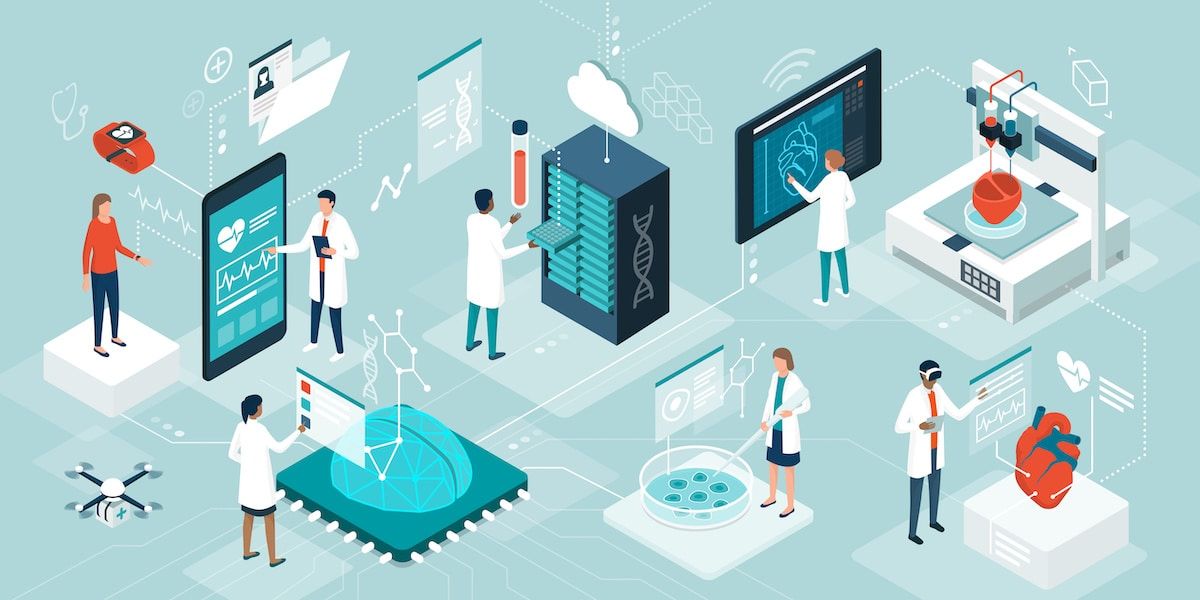
Artificial intelligence in healthcare is becoming part of everyday clinical workflows, while telemedicine, connected medical devices, robotics, cloud computing, predictive analytics and digital health platforms are changing how healthcare is delivered.
The shift is significant. An American Medical Association survey published in 2026 found that 81% of physicians surveyed reported using AI professionally, with applications ranging from summarizing medical research to documentation and patient communication.
But the most important healthcare technology trend isn’t simply “more technology.” It is the movement from reactive healthcare toward predictive, personalized and continuously connected care.
The question for hospitals, clinics, healthcare professionals and patients is therefore changing from “Will technology transform healthcare?” to “How can we adopt it responsibly and make it genuinely useful?”
The Biggest Healthcare Technology Trends Shaping Modern Medicine
Healthcare innovation is happening across several connected areas. Some technologies support clinicians directly, while others improve how patients monitor and manage their health.
| Technology | Main Application | Potential Impact |
|---|---|---|
| Artificial intelligence | Diagnosis, documentation, prediction and decision support | Faster and more data-driven care |
| Generative AI | Clinical documentation, research and patient communication | Reduces administrative workload |
| Telemedicine | Remote consultation and follow-up | Expands access to specialists |
| Wearable devices | Continuous health monitoring | Earlier detection and prevention |
| Robotics | Surgery, rehabilitation and hospital automation | Greater precision and efficiency |
| IoT medical devices | Connected monitoring and equipment | Real-time healthcare data |
| Big data analytics | Population and clinical analysis | Better planning and decision-making |
| 3D printing | Prosthetics, implants and surgical planning | Personalized medical solutions |
| Cloud healthcare platforms | Data storage and interoperability | Connected healthcare ecosystems |
The real opportunity comes when these technologies work together rather than operating as isolated tools.
1. Artificial Intelligence in Healthcare: From Experiment to Everyday Tool
Artificial intelligence is arguably the most influential healthcare technology trend today.
AI systems can analyze large volumes of medical information much faster than humans. Depending on the application, they can assist with medical imaging, identify patterns in patient records, support clinical decision-making, summarize research and automate repetitive administrative tasks.
The FDA maintains an evolving list of AI-enabled medical devices authorized for marketing in the United States, demonstrating how AI is moving from experimental projects into regulated medical products.
Where is AI already making a difference?
AI can assist with:
- Medical image analysis
- Clinical documentation
- Patient risk prediction
- Drug discovery
- Medical research
- Disease surveillance
- Appointment and workflow management
- Personalized treatment support
- Patient communication
- Administrative automation
One particularly practical application is reducing paperwork.
Doctors don’t necessarily need AI to “replace” their clinical judgment. They often need technology to eliminate tasks that consume time without requiring their highest-level expertise.
That distinction matters.
The AMA reported that addressing administrative burden through automation was the leading opportunity identified by physicians, while privacy assurances and integration with electronic health records were among the important requirements for adoption.
The next step: Generative and multimodal AI
Generative AI goes beyond analyzing existing information. It can produce text, summarize documents, interpret multiple forms of information and assist with complex workflows.
The World Health Organization’s guidance on large multimodal models notes that these systems can work across inputs such as text, images and video, creating potential applications across healthcare, research and drug development.
However, healthcare cannot treat AI like an ordinary productivity app.
A confident but incorrect AI output can have serious consequences. Human oversight, clinical validation, privacy protection and clear accountability remain essential.
2. Telemedicine and Virtual Care
Telemedicine has changed the traditional assumption that healthcare requires patients and clinicians to be in the same physical location.
A patient can now consult a physician remotely, receive follow-up care, share digital reports and, in some cases, transmit health information through connected devices.
Telemedicine can be particularly valuable for:
- Rural and underserved communities
- Follow-up consultations
- Chronic disease management
- Mental health services
- Specialist consultations
- Post-operative monitoring
- Routine healthcare questions
But telemedicine shouldn’t be viewed as a universal replacement for physical care.
Some conditions still require physical examination, diagnostic testing or emergency intervention.
The better model is often hybrid healthcare: combining digital convenience with face-to-face clinical care when necessary.
3. Wearables and Remote Patient Monitoring
Smartwatches and connected health devices have evolved beyond counting steps.
Modern wearable technologies can collect information such as heart rate, activity patterns, sleep data and, depending on the device, other health measurements.
The important innovation isn’t the device itself. It is the continuous stream of information.
Traditional healthcare often provides a snapshot:
Patient visits doctor → measurements are taken → treatment is recommended.
Connected healthcare can create a longer picture:
Data is collected continuously → changes are detected → healthcare professional reviews relevant information → intervention occurs when appropriate.
This could support earlier identification of concerning trends, particularly in chronic disease management.
However, more data doesn’t automatically mean better healthcare. Poor-quality measurements, unnecessary alerts and patient anxiety can create new problems.
The future therefore isn’t about collecting everything. It is about collecting the right information and turning it into useful clinical insight.
4. Robotics and Automation
Robotics is another major healthcare innovation, particularly in surgery, rehabilitation and hospital logistics.
Robotic-assisted surgical systems can help clinicians perform complex procedures with enhanced precision and control. Meanwhile, rehabilitation robots can support patients recovering from injury or neurological conditions.
Automation is also appearing behind the scenes.
Hospitals can use automated systems for:
- Medication and supply logistics
- Laboratory workflows
- Equipment management
- Sterilization processes
- Inventory tracking
- Patient transportation
This creates an important but often overlooked trend: healthcare technology isn’t only about treating patients; it’s also about making healthcare organizations operationally smarter.
For clinics and hospitals, better inventory systems, connected equipment and automated workflows can reduce delays and improve resource utilization.
5. Internet of Medical Things (IoMT)
The Internet of Medical Things, or IoMT, connects medical devices to digital networks so that information can be collected, transmitted and analyzed.
Examples include connected:
- Patient monitors
- Glucose monitoring systems
- Wearables
- Infusion equipment
- Hospital beds
- Diagnostic devices
- Imaging systems
Imagine a hospital where equipment status, patient measurements and maintenance information can be monitored through connected systems.
That creates opportunities for predictive maintenance, faster response times and more efficient resource management.
But connectivity introduces another responsibility: cybersecurity.
Healthcare organizations must protect sensitive patient information and connected devices from unauthorized access.
Technology that improves healthcare while creating unacceptable security risks is not true innovation.
6. Big Data and Predictive Healthcare
Healthcare generates enormous quantities of information—from electronic health records and laboratory results to medical images, genomic data and wearable-device readings.
Big data analytics can help transform this information into actionable insights.
Instead of asking only:
“What happened to this patient?”
healthcare systems increasingly want to ask:
“What is likely to happen next?”
Predictive analytics may help identify patients at higher risk of complications, support population-health management and help healthcare organizations allocate resources more effectively.
This represents a fundamental change from reactive to proactive healthcare.
Yet predictive models are only as reliable as the data and methodology behind them. Poor-quality or biased datasets can produce unreliable recommendations.
Healthcare Technology: Innovation vs. Real-World Adoption
Technology can look impressive in a demonstration and still fail in a busy clinic.
That is one of the biggest lessons from healthcare innovation.
| Innovation-first approach | Patient-first approach |
| “Can we build it?” | “Does it solve a real problem?” |
| Focuses on features | Focuses on outcomes |
| Adds another platform | Integrates with existing workflows |
| Collects maximum data | Collects useful data |
| Prioritizes automation | Keeps human oversight |
| Measures adoption | Measures clinical and operational value |
A successful healthcare technology should ideally make at least one of these things better:
care quality, patient safety, access, efficiency, affordability or clinician experience.
If it does none of them, being technologically advanced isn’t enough.
The Biggest Challenges Facing Healthcare Technology
Despite enormous potential, healthcare innovation faces serious barriers.
Data privacy and cybersecurity
Healthcare data is among the most sensitive forms of personal information. Connected systems therefore need strong security, access controls and responsible data-management practices.
AI bias and reliability
AI models can produce inaccurate or biased outputs when their training data or implementation is flawed.
The WHO emphasizes that AI adoption must address safety, ethics, equity, governance and human rights.
Interoperability
A hospital may use dozens of software platforms and devices. If these systems cannot communicate effectively, healthcare professionals may spend more time moving information between systems than using it.
Cost and accessibility
Advanced technology can be expensive. Healthcare organizations must consider whether an innovation is scalable and accessible—not simply whether it is impressive.
Human trust
Patients may be comfortable using technology for scheduling but much more cautious when AI becomes involved in diagnosis or treatment.
Trust must therefore be earned through transparency, evidence and accountability.
A New Healthcare Model: Human Expertise + Intelligent Technology
The most realistic future of healthcare isn’t doctors versus machines.
It is doctors with better machines.
AI can process information. Clinicians understand context.
Wearables can collect data. Healthcare professionals determine what matters.
Robotics can improve precision. Surgeons remain responsible for clinical decisions.
Telemedicine can increase access. Healthcare teams still provide human care.
This principle is especially important because WHO has repeatedly emphasized that AI should support people-centered and equitable health systems rather than deepen existing inequalities.
Healthcare technology should therefore be designed around the people using it—not simply around the technology itself.
What Healthcare Organizations Should Do Next
Hospitals, clinics, pharmacies and healthcare businesses don’t need to adopt every new technology.
A smarter approach is to start with a genuine operational or clinical problem.
Before investing, ask:
- What problem are we solving?
- Does the technology have credible evidence behind it?
- Can it integrate with our existing systems?
- How will patient data be protected?
- Who remains accountable for decisions?
- How will we measure success?
- Can staff and patients actually use it comfortably?
For organizations evaluating AI specifically, the NIST AI Risk Management Framework provides a useful framework for thinking about trustworthy AI, including risk identification and management.
The Future of Healthcare Technology
The next generation of healthcare won’t be defined by one breakthrough.
Instead, several technologies will increasingly converge:
AI + connected devices + cloud platforms + medical data + robotics + telemedicine + personalized medicine.
This convergence could enable healthcare systems that detect problems earlier, personalize interventions and automate routine work while allowing clinicians to focus more heavily on patients.
Investment trends also indicate that digital health remains an active innovation sector. Rock Health reported that U.S. digital health startups raised $14.2 billion across 482 deals in 2025, a 35% increase from 2024, with AI-enabled companies accounting for 54% of total funding.
But investment alone doesn’t guarantee better healthcare.
The winners will likely be technologies that can prove three things:
They work. They integrate. They improve outcomes.
Conclusion: Technology Should Make Healthcare More Human
Healthcare technology is moving rapidly from futuristic concept to everyday infrastructure.
Artificial intelligence in healthcare, telemedicine, wearables, robotics, IoMT, predictive analytics and cloud-based platforms are reshaping how healthcare professionals work and how patients access care.
But the ultimate measure of innovation shouldn’t be how sophisticated a technology looks.
It should be whether a patient receives safer care, a clinician gets more time to focus on patients, a hospital operates more efficiently, or someone gains access to healthcare they couldn’t previously reach.
The future belongs not to technology alone, but to responsible technology working alongside human expertise.
Ready to Embrace the Future of Healthcare?
Whether you’re a healthcare professional, clinic owner, hospital administrator or healthcare business, now is the time to evaluate which technologies can genuinely improve your workflow and patient experience.
Explore our related healthcare technology, medical equipment and healthcare solutions content, share your thoughts on the technologies you’re already using, and stay connected for more practical insights into the future of healthcare.
Suggested Internal Links
Add links to relevant pages on your own website using natural anchor text such as:
- Medical Equipment Buying Guide
- Essential Healthcare Products for Clinics
- Dental Clinic Inventory Management
- Surgical Instruments Buying Guide
- Healthcare Products Buying Guide
- How to Choose Medical Equipment for a New Clinic
Recommended Visuals
Hero image: A modern hospital combining AI, robotics, wearable technology, telemedicine and connected medical devices.
Infographic: “7 Healthcare Technologies Transforming Modern Medicine” featuring AI, telemedicine, wearables, robotics, IoMT, big data and 3D printing.
Comparison graphic: “Traditional Healthcare vs. Technology-Enabled Healthcare.”