
Category: Dental — Orthodontics & Occlusion | Medical Specialist: Orthodontist; dentist; oral and maxillofacial specialist when indicated | References: American Association of Orthodontists (AAO); ADA
Introduction: When Your Bite Doesn’t Quite Fit
Have you ever looked in the mirror and noticed crowded teeth, a prominent overbite, or a lower jaw that seems to sit farther forward? You may have wondered whether it is simply a cosmetic issue—or something that could affect your oral health.
That is where Malocclusion comes in.
Malocclusion describes an abnormal relationship between the upper and lower teeth or jaws when the mouth closes. In everyday language, it is often called a “bad bite.” It can range from mild crowding that causes little trouble to complex jaw discrepancies that affect chewing, speech, comfort, or dental health.
Importantly, not every unusual-looking bite needs treatment. The real question is whether the bite is interfering with function, oral health, facial development, comfort, or the person’s goals.
This distinction is one of the most useful things to understand before considering braces or clear aligners.
What Is Malocclusion?
Occlusion refers to the way the upper and lower teeth come together. Ideally, the teeth meet in a coordinated pattern that supports biting, chewing and speaking. Malocclusion occurs when the teeth or jaws do not relate to one another normally.
It is not always obvious. A person may have visibly crooked front teeth but relatively good function, while another may have a less noticeable bite discrepancy that places excessive forces on certain teeth.
In other words, straight teeth do not automatically mean a perfect bite—and a less-than-perfect smile does not automatically mean a serious problem.
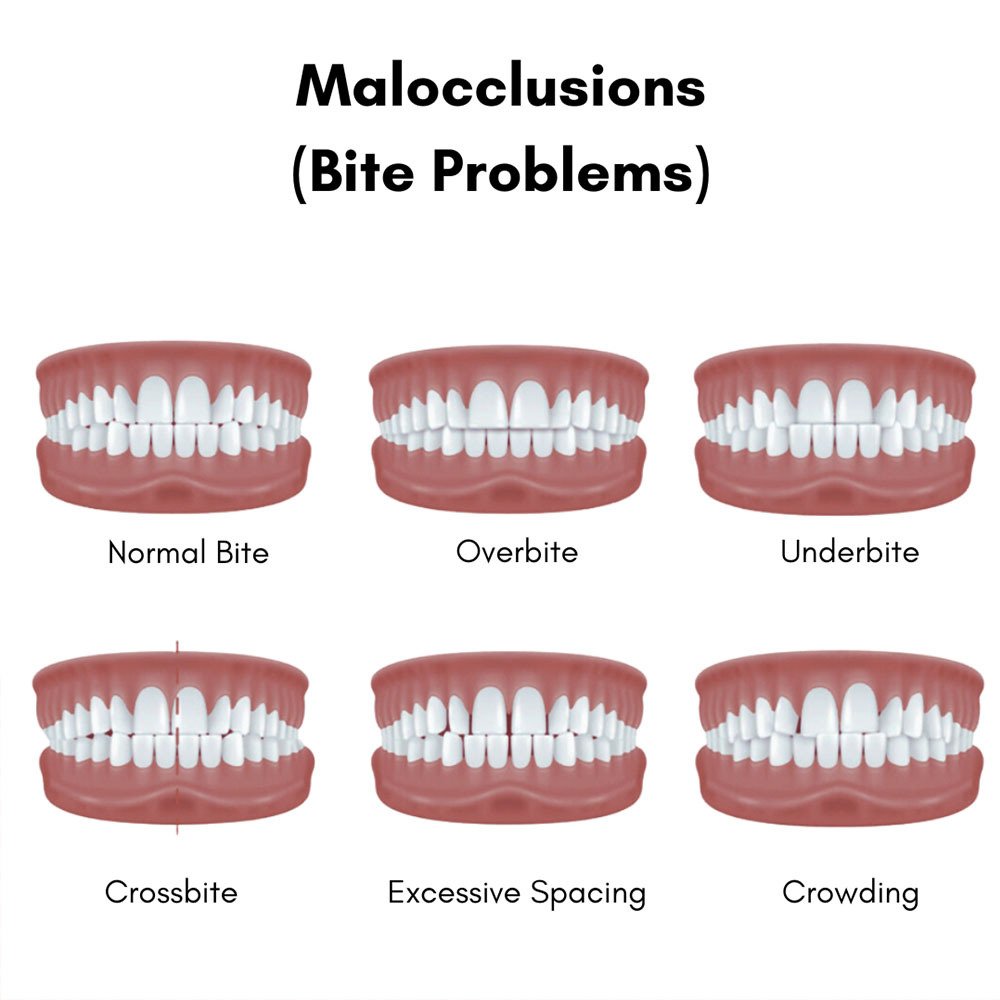
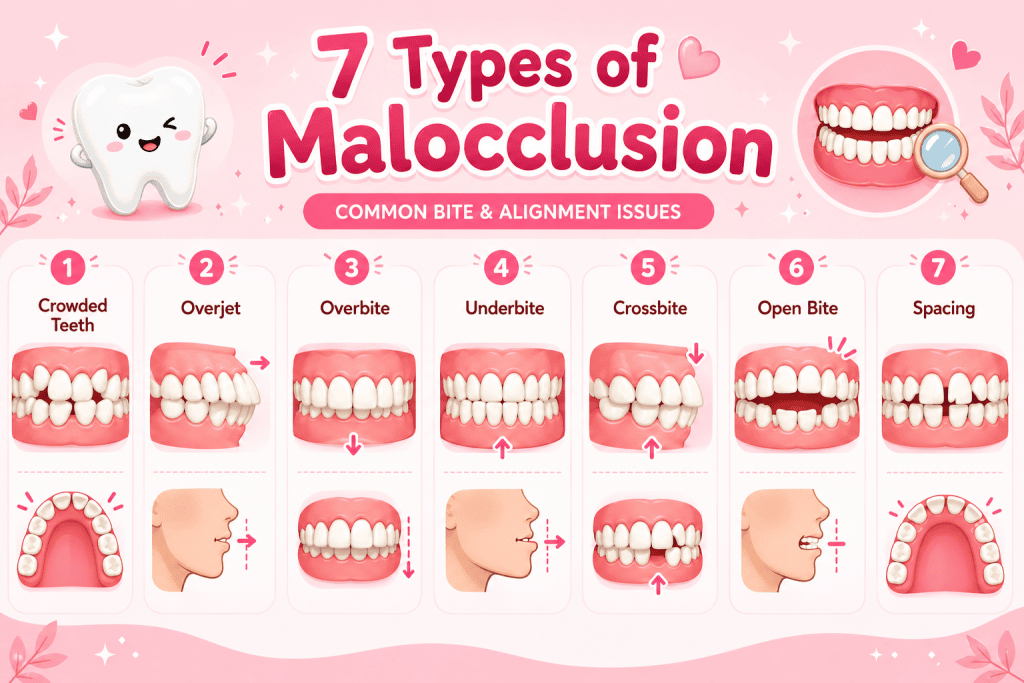
Common Types of Malocclusion
| Type | What it means | Common appearance |
|---|---|---|
| Class I | Back teeth have a relatively normal relationship, but crowding, spacing or other bite problems may exist | Crooked or spaced teeth |
| Class II | Lower teeth or jaw are positioned behind the upper teeth/jaw | Overjet or prominent upper front teeth |
| Class III | Lower teeth or jaw are positioned ahead of the upper teeth/jaw | Underbite |
| Overbite / Deep bite | Upper front teeth overlap the lower front teeth excessively | Lower front teeth partly covered |
| Open bite | Some teeth do not meet when the jaws are closed | Gap between upper and lower teeth |
| Crossbite | One or more upper teeth bite inside or outside the corresponding lower teeth | Teeth appear to “cross” |
| Crowding | There is insufficient space for teeth to align properly | Overlapping or rotated teeth |
| Spacing | Excess space exists between teeth | Noticeable gaps |
The American Association of Orthodontists (AAO) recognizes Class I, II and III relationships as important orthodontic classifications, while problems such as open bite, crossbite, overbite and overjet describe specific features of the bite.
What Causes Malocclusion?
Malocclusion rarely has one single cause. In many patients, several factors interact while the teeth and jaws are developing.
1. Tooth and Jaw Size Mismatch
One of the most common underlying factors is a mismatch between tooth size and jaw size.
For example, if the teeth are relatively large compared with the available jaw space, crowding can develop. Conversely, a relatively large dental arch or smaller teeth may contribute to spacing.
2. Genetics and Jaw Development
The shape and growth pattern of the jaws are strongly influenced by genetics.
A child may inherit a tendency toward a small upper jaw, a prominent lower jaw, or particular facial growth patterns. This is one reason orthodontic problems can appear to “run in families.”
3. Childhood Oral Habits
Some habits can influence developing teeth and jaws, particularly when they persist over time.
Examples include:
- Prolonged thumb or finger sucking
- Tongue thrusting
- Certain patterns of mouth breathing
- Other persistent oral habits
Thumb sucking and tongue thrusting can place repeated forces on the developing teeth and contribute to problems such as increased protrusion or open bite.
4. Premature Loss of Baby Teeth
Baby teeth do more than help children chew. They also help maintain space for permanent teeth.
If a primary tooth is lost too early because of decay or trauma, neighboring teeth can drift into the space. That may reduce the room available for the permanent tooth that eventually needs to erupt.
This is why treating childhood dental problems early can sometimes have orthodontic benefits later.
5. Missing or Lost Permanent Teeth
Losing a permanent tooth can change the balance of the dental arch. Adjacent teeth may move into the empty space, while opposing teeth can shift vertically. Over time, this can contribute to a more complex bite.
6. Trauma and Developmental Conditions
Jaw fractures, certain congenital conditions, and developmental differences can also affect tooth and jaw relationships.
For these patients, orthodontic treatment may need to be coordinated with other dental or medical care.
Symptoms of Malocclusion
Some people notice Malocclusion immediately. Others live with it for years without realizing their bite is unusual.
Possible signs and symptoms include:
- Crowded, overlapping or rotated teeth
- Gaps between teeth
- Prominent upper front teeth
- Underbite
- Crossbite
- Difficulty biting certain foods
- Difficulty chewing efficiently
- Teeth that repeatedly chip or wear unevenly
- Accidental biting of the cheek or tongue
- Speech difficulties in some cases
- Difficulty keeping crowded areas clean
- Jaw discomfort in some patients
However, an important clinical point is worth emphasizing: jaw pain should not automatically be blamed on Malocclusion.
The National Institute of Dental and Craniofacial Research notes that there is no evidence supporting the idea that malocclusion itself is a general cause of temporomandibular disorders (TMD).
That means someone experiencing jaw pain deserves an appropriate evaluation rather than simply being told that their teeth need to be straightened.
How Can Malocclusion Affect Oral Health?
A poorly positioned tooth may be harder to brush and floss effectively. Crowded areas can therefore make plaque control more challenging.
Depending on the individual’s bite, uneven forces may also contribute to abnormal tooth wear, fractures or mobility. MSD Manual notes that improperly distributed chewing forces can contribute to tooth wear and, in severe cases, damage to teeth and supporting structures.
There can also be functional consequences.
Severe Malocclusion may interfere with:
- Biting
- Chewing
- Speaking
- Maintaining oral hygiene
- Protecting teeth from excessive trauma
This is why orthodontics is not simply about creating a straighter smile. The broader goal is to establish a healthy, functional bite.
Diagnosing Malocclusion
Diagnosis usually begins with a detailed dental and orthodontic examination.
An orthodontist may evaluate:
- Facial symmetry and profile
- Jaw position
- Tooth alignment
- Overbite and overjet
- Crossbites
- Tooth crowding and spacing
- Dental midlines
- Jaw movement
- Oral habits
- Previous dental treatment
Depending on the situation, diagnostic records may include photographs, dental models or digital scans and X-rays.
A panoramic X-ray can provide a broad view of the teeth and supporting structures, while a cephalometric radiograph provides a side view useful for evaluating jaw and facial relationships.
More advanced imaging, such as cone-beam CT, is reserved for situations where three-dimensional information is clinically useful.
Malocclusion Treatment: What Are the Options?
Treatment depends on the patient’s age, the severity and type of Malocclusion, jaw growth, dental health and treatment goals.
There is no single “best” appliance for everyone.
1. Traditional Braces
Conventional braces use brackets, wires and other components to apply controlled forces to teeth.
They remain a highly versatile option, particularly for complex tooth movements.
2. Clear Aligners
Clear aligners use a sequence of removable appliances to gradually move teeth.
They can be attractive to adults and teenagers who prefer a less noticeable option. However, aligners are not automatically appropriate for every case. The complexity of the tooth and jaw problem should determine the treatment approach—not simply the appearance of the appliance.
3. Functional or Growth-Modifying Appliances
In selected growing children, orthodontic appliances may be used to influence jaw relationships or manage developing bite problems.
Timing can matter because growing jaws provide opportunities that may not exist to the same extent after growth is complete.
4. Tooth Extraction
In some crowded cases, removing selected teeth can create the space needed to align the remaining teeth.
Extraction is not required for everyone with crowding. It is a case-specific decision based on factors such as facial profile, tooth size, available space, periodontal considerations and the overall treatment plan.
5. Orthognathic Surgery
When a significant jaw discrepancy is primarily skeletal and cannot be adequately corrected with tooth movement alone, corrective jaw surgery may be considered.
Orthognathic surgery is generally coordinated with orthodontic treatment before and after surgery. The AAO describes it as corrective jaw surgery used for skeletal problems affecting functions such as biting, chewing and speaking.
Braces vs Clear Aligners: Which Is Better?
The answer depends on the individual case.
| Feature | Braces | Clear Aligners |
| Visibility | More noticeable | Less noticeable |
| Removability | Fixed | Removable |
| Hygiene | Requires careful brushing around brackets | Easier to brush normally when removed |
| Compliance | Less dependent on wearing time | Requires consistent wear |
| Complex movements | Highly versatile | Effective for many cases, but case selection matters |
| Eating | Food restrictions may be needed | Usually removed while eating |
| Appearance | Traditional orthodontic look | More discreet |
The most important takeaway is that treatment should be selected according to diagnosis, not marketing.
A consultation with a qualified orthodontic professional can determine whether braces, aligners, appliances, monitoring or another approach makes sense.
Can Malocclusion Be Prevented?
Not all Malocclusion can be prevented because genetics and jaw development play major roles.
Still, early dental care can reduce some avoidable contributors.
Parents can help by:
- Establishing good oral hygiene early
- Treating cavities promptly
- Discussing persistent thumb-sucking with a dentist
- Attending regular dental checkups
- Protecting children’s teeth during sports
- Seeking evaluation when permanent teeth appear severely crowded or displaced
- Addressing premature loss of baby teeth appropriately
Early identification does not necessarily mean immediate braces. Sometimes the best treatment is simply monitoring growth and dental development.
Key Insights: What People Often Get Wrong About Malocclusion
Myth 1: “Malocclusion is only cosmetic.”
Not necessarily. Some cases are mainly aesthetic, while others can interfere with chewing, speaking, oral hygiene or tooth health.
Myth 2: “Everyone with crooked teeth needs braces.”
No. Treatment depends on the individual’s diagnosis, function, oral health and personal goals.
Myth 3: “Aligners are always better than braces.”
Not necessarily. Aligners are an excellent option for many patients, but appliance selection should follow the clinical problem.
Myth 4: “Jaw pain means my bite is wrong.”
Not automatically. TMD has multiple potential causes, and current evidence does not support treating malocclusion as a universal cause of TMD.
Myth 5: “Orthodontic treatment is only for teenagers.”
Adults can also receive orthodontic treatment. The key considerations are dental health, bone and gum condition, the type of bite problem and overall treatment objectives.
When Should You See an Orthodontist?
Consider an orthodontic evaluation if you notice:
- Significant crowding or spacing
- A pronounced overbite or underbite
- A crossbite
- Difficulty biting or chewing
- Teeth that are wearing or chipping unusually
- A developing bite problem in a child
- Persistent difficulty keeping certain teeth clean
- A noticeable change in how the teeth fit together
An orthodontic consultation does not automatically mean you need treatment. It provides an opportunity to understand what is happening and whether observation or intervention is appropriate.
Conclusion
Malocclusion is more than crooked teeth. It describes a broad range of relationships between teeth and jaws, from minor alignment differences to complex skeletal problems.
The causes can include genetics, tooth-jaw size discrepancies, childhood habits, premature tooth loss, missing teeth and trauma. Symptoms vary widely, and some people may have substantial Malocclusion without significant discomfort.
Treatment is equally individual. Braces, clear aligners, functional appliances, extraction and corrective jaw surgery all have roles—but the right choice depends on a proper diagnosis.
Perhaps the most important perspective is this: the goal of orthodontics should not simply be a straight-looking smile. It should be a stable, functional and healthy bite that fits the person’s needs.
If you have noticed crowding, an unusual bite, difficulty chewing or changes in how your teeth meet, consider scheduling a dental or orthodontic evaluation rather than trying to diagnose the problem from appearance alone.
Have questions about your bite or orthodontic treatment? Explore our related dental-care resources, share this guide with someone considering braces or aligners, and speak with a qualified dental professional for personalized advice.
Suggested Internal Links
For your website, consider naturally linking this article to related content such as:
- [Understanding Gingivitis: Causes, Symptoms & Treatment]
- [Understanding Dental Caries (Tooth Decay): Causes, Symptoms & Treatment]
- [Dental Care Guide: Essential Dental Products, Instruments, Materials & Procedures]
- [How to Choose the Right Dental Chair for Your Clinic]
- [Dental Consumables: A Complete Buying Guide]
Authoritative External Resources
- American Association of Orthodontists — Orthodontic Glossary
- NIDCR — Temporomandibular Disorders
- MSD Manual — Malocclusion
Medical Disclaimer: This article is intended for general educational purposes and does not replace an examination, diagnosis or treatment plan from a qualified dentist or orthodontist.